THE PARISH CHURCHES of
NORTH MARSTON and GRANBOROUGH
SERMON FOR THIS WEEK

Sunday 11th October 2026
TRINITY 20
POVERTY SUNDAY
Then he said to them, ‘So give back to Caesar what is Caesar’s, and to God what is God’s.’
Matthew 22:21
Sermon preached on 18th October 2026
20th Sunday after Trinity; Poverty Sunday
By Richard Webster
READINGS
1 Thessalonians 1: 1-10
Paul, Silas and Timothy,
To the church of the Thessalonians in God the Father and the Lord Jesus Christ:
Grace and peace to you.
2 We always thank God for all of you and continually mention you in our prayers. 3 We remember before our God and Father your work produced by faith, your labour prompted by love, and your endurance inspired by hope in our Lord Jesus Christ.
4 For we know, brothers and sisters loved by God, that he has chosen you, 5 because our gospel came to you not simply with words but also with power, with the Holy Spirit and deep conviction. You know how we lived among you for your sake. 6 You became imitators of us and of the Lord, for you welcomed the message in the midst of severe suffering with the joy given by the Holy Spirit. 7 And so you became a model to all the believers in Macedonia and Achaia. 8 The Lord’s message rang out from you not only in Macedonia and Achaia – your faith in God has become known everywhere. Therefore we do not need to say anything about it, 9 for they themselves report what kind of reception you gave us. They tell how you turned to God from idols to serve the living and true God, 10 and to wait for his Son from heaven, whom he raised from the dead – Jesus, who rescues us from the coming wrath.
Matthew 22:15-22
15 Then the Pharisees went out and laid plans to trap him in his words. 16 They sent their disciples to him along with the Herodians. ‘Teacher,’ they said, ‘we know that you are a man of integrity and that you teach the way of God in accordance with the truth. You aren’t swayed by others, because you pay no attention to who they are. 17 Tell us then, what is your opinion? Is it right to pay the poll-tax to Caesar or not?’
18 But Jesus, knowing their evil intent, said, ‘You hypocrites, why are you trying to trap me? 19 Show me the coin used for paying the tax.’They brought him a denarius, 20 and he asked them, ‘Whose image is this? And whose inscription?’
21 ‘Caesar’s,’ they replied.
Then he said to them, ‘So give back to Caesar what is Caesar’s, and to God what is God’s.’
22 When they heard this, they were amazed. So they left him and went away.
TALK
Who do you serve?
Any good or bad sermon will often start with a personal comment or questions to the gathered congregation. An attempt to win people over, to get them interested, or not depending on the questions or anecdotes shared, on what the preacher wants to get across. This can backfire. The congregations find the comments or questions boring, offensive, irrelevant to them and any chance of the preacher gaining their attention is lost.
Today is no different but I think I can get away with it given today’s readings, Jesus was being asked questions by the religious leaders. They were trying to trick him, to make him say something which they could use against him. Not quite like Prime minister’s question time but perhaps there are parallels. Before we start let me say one thing. I am not trying to trick you.
These may sound strange questions given that we are in a church on a Sunday morning in the middle of a family service but who or what do you idolise? Who or what do you worship? Who or what do you ‘follow’ on media platforms?
Celebrities, Pop stars, Sports teams, ‘content makers’, politicians………family and friends, religions
Why are these people, things or organisations important to you? What makes them special?
Is it reflected glory, comfort, a sense of connection, support and help, escape from reality?
Our answers tell us a lot about who we are as humans and as individuals.
We need to find something or someone to look up to
We need a sense of attachment
We need to bask in reflected glory, good or bad
We need to project an alternative life onto our own
If we look at our first reading, which many scholars say was the first book of the NT to be written, we hear Paul encouraging the embryonic church in Thessolonica. He has spent time with them and now writes to encourage them to hold firm to their beliefs. They like all the early churches are having to go through changes and challenges.
They are being challenged by those who are not Christian and yet they are choosing not to worship the other gods/idols that the others are worshiping. This because of their faith which Paul commends them for. Their faith prompts them into action. Paul tells them they have become a model church to believers elsewhere.
How would you summarise the Thessalonian church which Paul claims was remarkable because they were transformed by the gospel. Their lives have demonstrated that:
-
Faith that worked
-
Love that served
-
Hope that endured
-
They are a witness that influenced others
-
They have a commitment to turn from idols
-
And a readiness for Christ's return
Our gospel reading highlights an interesting dilemma. Who do you serve? Can you serve two mastesr?
I don’t know if you have ever seen the play One Man, Two Guvners. A comedic take on the problems that can arise when one man tries to serve two masters at the same time. The man tries to keep the two from meeting in order to avoid each of them learning that he is also working for someone else. Mayhem ensues.
In our reading the religious leaders are trying to trick Jesus. They try again later in the chapter asking who will be married to who in heaven and which is the greatest commandment. They are asking question about loyalty.
To us the key question is how should followers of Jesus act towards to authorities secular and religious?
On the face of it the answer to the question asked of Jesus is quite simple. Who’s face is on the coin? he asks – there’s your answer – your taxes go to Caeser
But it is not so black and white when it comes to other aspects of life, to our faith
Who has the authority?
Who is to be followed?
What happens when there is a conflict?
What happens when one person tells you to do it one way and another a different way?
Who has the power?
These questions remain relevant today. The world constantly competes for our allegiance. Careers, politics, wealth, popularity, and personal ambition can all demand our devotion. Jesus calls us to examine where our ultimate loyalty lies.
Christians live with a form of dual citizenship. We are citizens of the nation in which we live and have certain responsibilities to that society and the world, but we are also citizens of God's Kingdom with all the responsibilities that go along with that.
We should respect governmental authority, pray for leaders, and fulfil civic duties. Yet our highest allegiance belongs to Christ. Where the boundaries between the two are Jesus did not say. It is for our own consciences to test.
What have we learnt. We have dual nationality – we need to follow both the conventions of our worldly society and also follow God teaching. We give to each in accordance to what is their due.
As Paul writes ‘they tell us that you have turned from idols to serve the living and true God and to wait for his Son from heaven whom he raised from the dead – Jesus who rescues us from the coming wrath’.
A final thought
It’s Poverty Sunday today
In 2026, the world bank estimated 10.0% of the global population, or roughly 810 million people, are projected to live in extreme poverty, surviving on less than $2.15 (£1.60) per day. The vast majority of these live in Africa, Pakistan, Afghanistan and the Middle East.
Extreme poverty is influenced by multiple factors:
-
Conflict and displacement: Civil wars and insurgencies exacerbate poverty in countries like South Sudan,
-
Climate shocks: Droughts, cyclones, and El Niño events disproportionately affect rural populations dependent on agriculture
-
Economic vulnerability: Resource-dependent economies, such as Zambia’s reliance on copper, leave populations exposed to global market fluctuations
By comparison, the number of people living in relative poverty in the UK rose by half a million in the year up to March 2025, government figures have shown.
There are now 13.4 million living in relative poverty, including four million children. The number of pensioners living in relative poverty increased from 1.49 million to 1.69 million.
A person is considered to be in relative poverty if they are living in households with income below 60% of the median average income of the population. This is approximately £64.20 (2025) which is 40 times the level of those in extreme poverty.
Family service with Baptism, 4th October 2026,
18th Sunday after Trinity; Season of creation 5
By Peter Evans
Reading - Mark 10: 13 - 16
Jesus Blesses Little Children
13 Some people brought children to Jesus for him to place his hands on them, but the disciples scolded the people. 14 When Jesus noticed this, he was angry and said to his disciples, “Let the children come to me, and do not stop them, because the Kingdom of God belongs to such as these. 15 I assure you that whoever does not receive the Kingdom of God like a child will never enter it.” 16 Then he took the children in his arms, placed his hands on each of them, and blessed them.
Talk
There’s an awful lot of ways to start a sermon. Sometimes with a joke, or an anecdote, but you’ll have noticed that we almost always start with prayer. It’s good to bring our minds before God as we approach this part of the service.
But there is a second best way to start a sermon and that’s with chocolate. Chocolate is one of God’s three best inventions. And in case you’re wondering. This isn’t straight forward bribery and corruption. Chocolate always has a serious point.
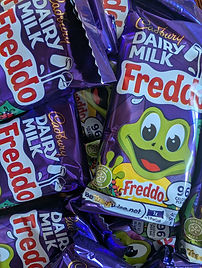
The chocolate in question is a Cadburys Freddo. Some of you will be aware, Freddos have a special place in our family. I once got into very serious trouble for eating my wife’s last Freddo. There were special, extenuating circumstances, but so much so, as news of my misdemeanour leaked out, kind people from church started posting Freddos through our door. Usually in sealed envelopes. Marked for Jayne only. Hands off, Peter, or words to that effect.
So, in our house, a Freddo is a big deal.
And my invitation to you is this. If you would like a Freddo, then do please come and get one. I’m happy for there to be a little bit of chaos, in fact a bit of chaos would be a good thing. And as far as I’m concerned. You can eat it right now. Subject to any necessary parental approvals.
And I know it might be tempting to take one back for others, but in this case, I’d really like you to come and get your own.
Now, I do understand that some of you would love to come, but are doing things like counting calories, or counting sugar or such like. Which is fine.
And just to reassure you, this isn’t just about indulging my chocolate habit, as I mentioned earlier, this does have a serious point, which we’ll come to later.
What an amazing passage it is that we had read to us earlier. Well known in many ways, and almost a little but of a cliché, it contains so much stuff that is directly relevant to this morning.
Jesus says many things throughout His ministry about what it takes to enter the Kingdom of Heaven. The danger of riches, for example – passing a camel through the eye of a needle and all that.
And here we have another one. We need to become as a little child to enter the Kingdom of Heaven.
Now, for anyone who is or has been involved in the parenting of young children, then we all know it’s not a walk in the park. There are challenges. The terrible twos. The troublesome threes. The wilful disobedience. The arguments. And all that before lunchtime. On a good day.
Lots of us have been there and got the T shirt – both as children and as parents.
And I’m pretty confident that this is not what Jesus is talking about when He says we need to be as little children to enter His Kingdom.
To help us dig around in this, I’d like us all to cast our minds back. Those of us who are still children will have a head start in this.
I want us to think back to something that made us happy as a child. That affirmed us in some way. And try and remember what you were feeling like. Why you were happy or affirmed. Why it’s a good memory.
If you are still a child, then that could be something from last week or last year, or whenever. But for the rest of us who are a bit older, let’s aim for something from when we were in between 5 and 10 years old.
I’m not going to ask you to share your memory, so don’t worry about that, but I am going to shut up for a minute or so to give us time to think back. And if it helps to close your eyes while we think back, then please do so.
I’m hoping that between us, we have a lot of good memories, and for those of us that are a bit older, that it reminds us a little of what being a child is like.
All being well, we’ll have been thinking of things along the following lines.
Feeling loved and cared for. Feeling special. Starting to feel independent. Becoming self-reliant. Having a view of the world that is very near at hand. – horizons that are right here and now. The importance of discovery and novelty. Of working things out. Of a more innocent view of the world. Open hearted, perhaps.
And on the flip side, the absence of baggage. The absence of self-importance. The absence of pride.
These are the qualities that Jesus is looking for in people who come to the Kingdom. Jesus calls us to Him. He wants us to come with open hearts. To put behind ourselves the baggage that we carry through life, the pride that runs through us, the “me first” attitude that is often part of us.
When Jesus calls us to repent, the word that is used in the gospels is metanoia – to change one’s mind, or to have a new mind. To leave behind the old things of life that get in the way of our relationship with God. To be renewed. To become new.
Jesus does call us to follow Him and to come to Him as a little child. Without baggage.
The chocolate activity earlier on shows us this. As a child, it’s very easy to go and get some chocolate. “I want some chocolate”. “It’s over there”. “I’ll go and get some”.
Adults on the other hand will think “well, this is for the children”. “I’d love some, but I don’t want to be seen to be too keen.” And all sorts of stuff along those lines.
I know it’s not easy weighing up the options, whether to go out and get some chocolate. Or not. And I’ll let you into a little secret. You all know how much I love chocolate. But if I’d been sitting in the pew and someone else was leading, I would have probably stayed put. Too much adult in me and not enough child.
And it’s kind of ironic that the disciples were trying to keep the children away from Jesus. Children were greatly valued and seen as a blessing from God, but their society was adults first. Especially when it came to teaching. And Jesus was seen as a teacher.
And so the disciples were behaving like Victorian family patriarchs. Children should be seen and not heard.
But not in Jesus’ Kingdom. Children have qualities that Jesus values, qualities that we all had once and some still have.
Jesus wants us to come to Him and be made anew. And this is what baptism is all about.
Baptism means washing, making clean by dipping or immersion. It symbolises being made anew.
And that’s what’s going to happen this morning for Matilda and Tabitha. The beginning of or a confirmation of a journey of faith. Baptism is an outward sign of inward grace. And as the gospel reading tells us, children coming to Jesus is a time of blessing.
Many of you will know that some churches only do what is known as believers baptism. Baptism for people who have found faith, and then the baptism becomes that believer’s public declaration of faith. If you’re not yet baptised, this could be something for you to think about.
And other churches, like ours, are happy to baptise young children and babies as well as those who have come to faith. Both approaches have their place. And in particular, with the baptism of babies and young children, promises are made by parents, godparents and the congregation on behalf of those being baptised.
My guess is that for most of us here, someone will have made promises for us when we were baptised as babies or children. Promises made for us to claim when we were older.
And just like the chocolate earlier, this is something that we have to do for ourselves. It might have seemed a bit mean saying that you could only collect a Freddo for yourself, but it illustrates the point. There are some things that only we can do.
And my question is this: have we claimed those promises?
Or are we sitting here with some unfinished business between us and God? It’s often said that God has no grandchildren – ie, that we cannot inherit our faith. It is something that we have to discover for ourselves. Something that only we can do.
So, if someone made these promises for us, on our behalf, when we were young, and they remained unclaimed, then Jesus still calls.
Calls us in that open and uncomplicated way that little children can easily understand.
Calls us with that promise of life made new, to be a citizen of the Kingdom of Heaven.
To a life lived for God, in His love, mercy and forgiveness. Washed clean and made whole for His glory.
Amen.